Chapter Wise MDCAT Model Test-1Chapter Wise MDCAT Model Test-1
Full Mdcat Pattern Test
Keep practicing — free MDCAT quizzes
After this academy paper, try topical chapter quizzes and Academy Sunday quizzes by subject.
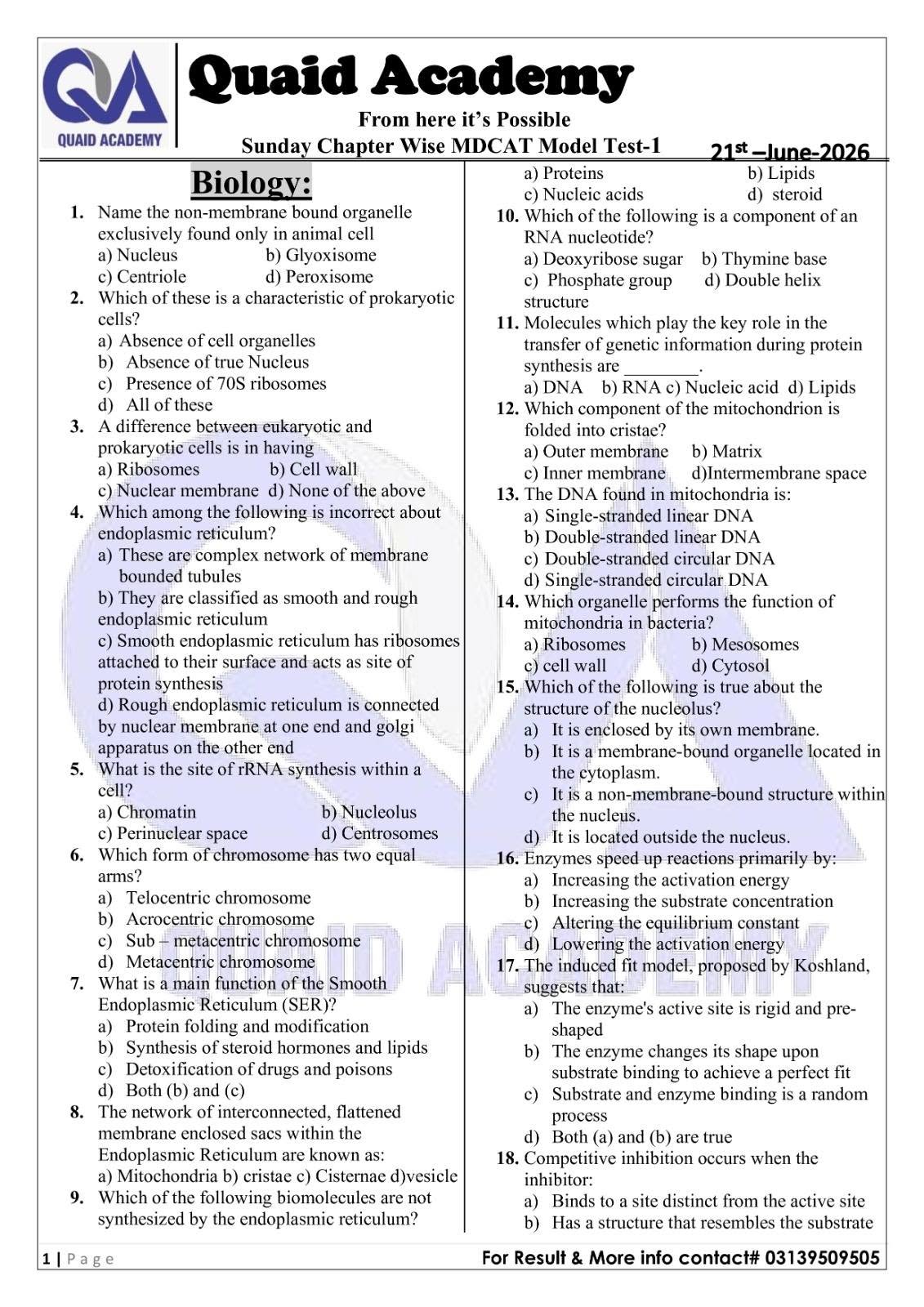
Test paper (PDF preview)
Comments (0)
Answer key
Answers:
Biology
1. c) Centriole
2. d) All of these
3. c) Nuclear membrane
4. c) Smooth endoplasmic reticulum has ribosomes attached to their surface and acts as site of protein synthesis
5. b) Nucleolus
6. d) Metacentric chromosome
7. d) Both (b) and (c)
8. c) Cisternae
9. c) Nucleic acids
10. c) Phosphate group
11. b) RNA
12. c) Inner membrane
13. c) Double-stranded circular DNA
14. b) Mesosomes
15. c) It is a non-membrane-bound structure within the nucleus.
16. d) Lowering the activation energy
17. b) The enzyme changes its shape upon substrate binding to achieve a perfect fit
18. b) Has a structure that resembles the substrate
19. b) A substance that binds covalently to the enzyme, permanently inactivating it.
20. a) Compound on which they work
21. a) Maltase
22. a) D-galactose and D-glucose
23. b) D-glucose and D-fructose
24. b) Endoplasmic Reticulum (ER)
25. c) Vesicles
26. c) Kinetochore
27. b) rRNA synthesis
28. c) Cellulose
29. c) Fructose
30. a) Muscle cells
31. c) Golgi Complex
32. c) Lysosomes
33. d) All
34. b) Animal cells are irregular/round, while plant cells are rectangular.
35. b) To decrease the activation energy of the reaction
36. b) They are consumed in the reactions they catalyze.
37. a) Translation
38. b) Lipid synthesis
39. d) Mechanical support
40. a) Nucleolus
41. d) Both B & C
42. b) Filamentous
43. d) Aldo-Hexose
44. b) Glycogen
45. c) Branched starch
46. b) Keratin
47. b) Pyrimidines
48. c) Adhesion and cohesion
49. c) Glycogen
50. c) Nucleic acid
51. c) 4°C
52. b) Sucrose
53. b) Deoxyribose
54. a) Cellulose
55. b) 2 amino acids
56. d) Trans face
57. a) Glycoprotein
58. c) Palmatic acid
59. d) Apoenzyme
60. d) Holoenzyme
61. c) Carbonic anhydrase
62. d) All of these
63. b) Induced-fit model
64. b) Prosthetic Group
65. d) 87KJ/mol
66. b) 4 → 0°C
67. b) Golgi apparatus
68. b) SER
69. c) Mitochondria
70. b) Nucleoid
71. c) Golgi apparatus
72. c) Mitochondria
73. d) Chromatin
74. c) Sarcoplasmic Reticulum
75. a) Endoplasmic Reticulum
76. b) Golgi Complex
77. d) Mitochondria
78. b) SER
79. b) Flexible active site
80. a) Non-competitive
81. c) 6000
Chemistry
82. a) 4s¹3d⁵
83. b) Electrons enter the lowest available energy level
84. d) b and c both
85. b) 2
86. d) Molecular shape
87. b) Decrease in bond angle
88. b) 3
89. c) 4g of He
90. b) 1.12 L
91. d) None
92. a) Hydrogen
93. d) Nitrogen > Helium > Hydrogen
94. a) 36
95. a) n
96. a) 9
97. a) ⁶C
98. d) All
99. b) N₂
100. a) Vector
101. b) NaCl
102. b) Anode to cathode
103. c) Protons
104. b) Spin quantum number
105. c) Beryllium
106. c) 4l + 2
107. b) Pauli Exclusion Principle
108. a) 0
109. d) All of these
110. d) 180g of glucose
111. b) 8 × Na
112. d) All of these
113. a) 6 moles
114. b) 1.5 mol
115. b) 2.0 moles of S₈
116. a) 1 mole of hydrogen atoms
117. a) 10.51 L (labeled as 10.51 CO₂)
118. c) 36g H₂O
119. a) 64g
120. a) 2
121. b) Reversible reaction
122. a) CO₂
123. b) sp² hybridization, trigonal planar shape
124. c) CH₄
125. d) sp³d → octahedral
126. b) 1 σ, 2 π
Physics
127. b) 1
128. b) 5N
129. a) A / √3
130. b) 15î + 10ĵ
131. c) ÂB̂ = B̂Â
132. b) 0°, 90° and 180°
133. b) 20√2 N-W
134. b) B⃗ = 2î + 1ĵ
135. d) 25km/hr
136. d) 315°
137. a) Tan⁻¹(1/3) vertical towards north
138. c) Zero
139. c) ABSinθ
140. c) 120°
141. c) Down
142. a) A⃗.B⃗/A
143. d) None
144. a) 10
145. c) C⃗ = A⃗ + B⃗
146. b) 30°
147. b) A straight line sloping up, slope = g
148. b) 4m/s
149. a) 30 m/s
150. b) 10 N s
151. a) 2 m/s
152. c) Both A & B
153. d) Zero
154. c) 17ms⁻¹
155. b) 2.5kg
156. a) 2m/s, 6m/s
157. b) 5.1m
158. b) 20m/s
159. a) 4m/s²
160. b) 13.5m
161. b) 12N.S
162. b) 9.8
English
163. b) Gerund phrase as object of verb
164. b) Infinitive phrase as subject
165. c) Gerund phrase
166. b) Infinitive phrase
167. b) Gerund phrase as subject
168. b) Gerund phrase after preposition
169. b) Infinitive phrase as subject
170. b) Infinitive phrase as object of verb
171. c) Gerund
Logical & Reasoning
172. d) O,F
173. a) P₁QVN
174. c) WWSS
175. d) + - ×
176. b) 74
177. c) K
178. a) 12
179. a) pqrpad
180. c) G







Register or Login to comment on this test.